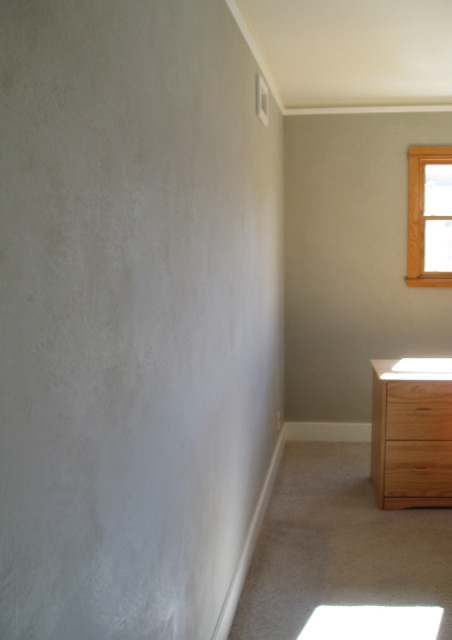
Calm green clay plaster for a dining room.
Clay plaster is a mixture of clay and sand that makes a beautiful, environmentally friendly alternative to conventional plaster and paint.
It is natural, non-toxic, durable and beautiful. Unlike most paint, it does not contain VOC’s (harmful chemicals that are released during and after application). The pigments used to color clay plaster are natural, non-fading and non-toxic, unlike the harsh chemical used to tint most paints.
Clay plaster can even help moderate humidity, inhibit mold growth and can contribute to better indoor air quality and acoustics. Its anti-static quality keeps it clean and it is easy to repair if damaged.
Unlike most modern plasters, clay plaster does not contain acrylic or resins, which take a lot of energy to produce. Clay is an abundant natural resource that takes very little energy to process into a plaster.
We specialize in making our own clay plasters from raw materials either from the job site or sourced as locally as possible. We are also trained installers of American Clay, a ready-mixed clay plaster manufactured in Albuquerque, New Mexico.
We are passionate about the many advantages of natural finishes and look forward to having the opportunity to work with you to include them in your renovation or building project. Contact us for more information: 619-342-6709
More about clay:
Clay has been used for building for as long as people have been building homes. It is a readily available raw material with a low environmental impact and needs minimal processing. By one estimate, there is enough clay to cover the surface of the earth with a layer one mile thick. Clay is naturally “sticky,” requiring no extra binders. When clay is moistened, the surface swells and seals, preventing liquid water from penetrating.
Clay occurs naturally in a range of colors and can also be tinted with pigments to create an almost unlimited color palette. Clay also has the ability to effectively store extra moisture and can help moderate indoor humidity. Clay plasters are very user-friendly and are easy to repair if damaged or to re-coat when a new color is desired.
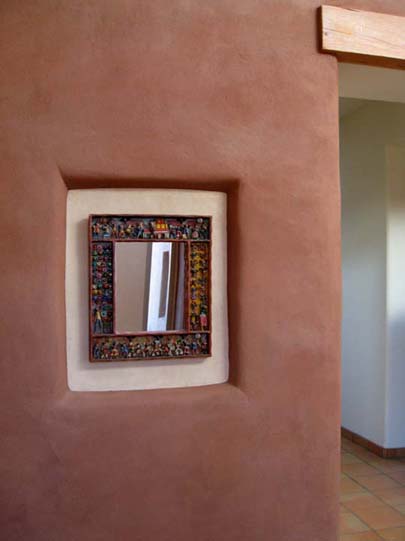
A nicho in a clay plastered wall.
Clay plaster can be used on almost any wall in a new or existing home, but it is a particularly good choice for straw bale walls because of its high vapor permeability. Moisture is a bale’s enemy, so plasters that allow water vapor to escape are essential.
Clay plaster can be a very environmentally friendly, low-impact way to finish walls. Unfired clay has low embodied energy (the energy that goes into making a product) and can often be sourced locally, lowering the energy required for shipping. The lovely red plaster shown here was made from clay-rich earth dug from the building site. Only small amendments were needed to make a superior interior finish plaster.